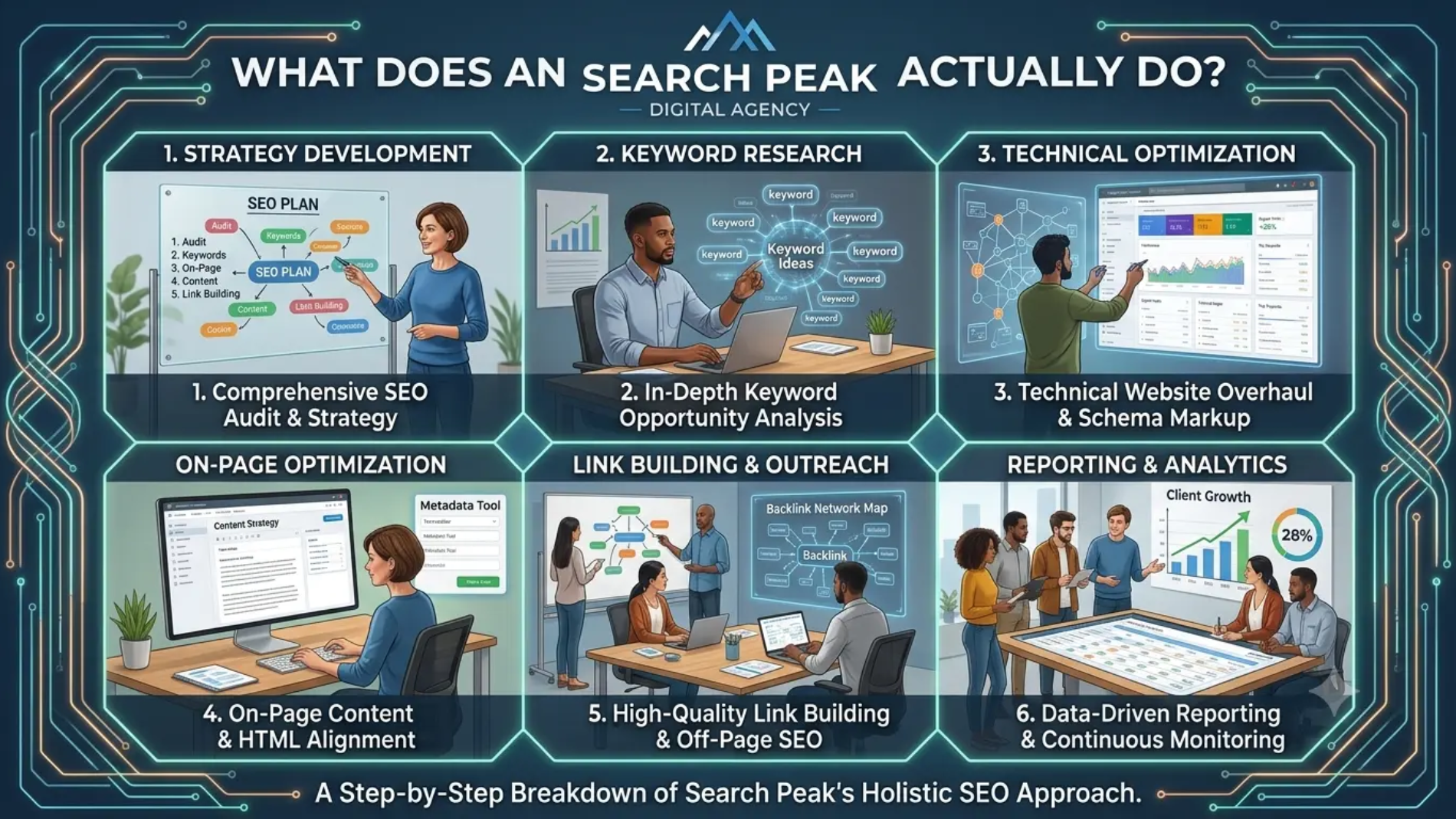
What do SEO companies do for roofing contractors?
A good SEO company helps your roofing business appear when local property owners search online. It improves your website, Google presence, content, reputation, and lead-tracking process.
However, rankings should never be the only goal.
The real goal is attracting qualified homeowners and commercial property managers. These people need roof repairs, replacements, inspections, or storm-damage services.
At Roof Rank SEO, every strategy should connect search visibility with calls, inspection requests, and profitable roofing projects.
What Is an SEO Company?
An SEO company helps businesses gain visibility in search engines and AI-powered search tools.
Many business owners search “what is SEO company” before hiring an agency. The simple answer involves much more than adding keywords.
A qualified agency studies:
- Your business goals
- Your roofing services
- Your service locations
- Your ideal customers
- Your local competitors
- Your current website
- Your lead-generation process
The agency then creates a plan for improving your online visibility.
An SEO company checks your website’s indexed and non-indexed pages because pages outside Google’s index cannot generate organic traffic or roofing leads.. SEO companies help remove problems that block those processes.
The best agencies also improve the journey after someone reaches your website.
That work can turn a search visitor into a booked roof inspection.
What Do SEO Companies Do for Roofing Companies?
A roofing SEO company combines research, technical work, content, local optimization, authority building, and conversion improvements.
Here is what that work should include.
1. Learn How Your Roofing Business Makes Money
A reliable agency starts with your business, not an automated website report.
Your SEO team should ask about:
- Your most profitable roofing services
- Your preferred project sizes
- Residential or commercial work
- Your service radius
- Your busy and slow seasons
- Your emergency availability
- Your sales process
- Your current lead sources
This information shapes the entire campaign.
For example, you may want fewer small repair jobs. Your company may prefer complete roof replacements.
Your SEO plan should reflect that goal.
An agency that only chases traffic may attract the wrong visitors. A business-focused agency targets searches connected with valuable projects.
2. Audit Your Website and Local Visibility
An SEO audit shows what helps or blocks your current performance.
The agency should review your website, Google Business Profile, citations, content, backlinks, competitors, and tracking systems.
A roofing SEO audit commonly checks:
- Pages missing from Google
- Broken internal links
- Duplicate pages
- Slow loading times
- Mobile usability
- Missing service pages
- Weak location pages
- Poor page titles
- Incorrect business details
- Thin or outdated content
- Spammy backlinks
- Missing conversion tracking
The audit should not become a long list of technical warnings.
Every issue needs a priority, reason, and recommended action.
A useful plan explains which problems affect leads first. It also separates urgent work from minor improvements.
3. Build a Roofing SEO Strategy
After the audit, the company creates an SEO roadmap.
It should prioritize the roofing SEO ranking factors that affect content quality, backlinks, technical performance, local visibility, and user experience.
A roofing SEO strategy may target three customer stages.
Awareness Stage
These searchers are learning about roofing problems.
Useful topics include:
- Signs of roof damage
- Causes of roof leaks
- What hail damage looks like
- How long roofing materials last
- When a roof needs replacement
Consideration Stage
These visitors are comparing solutions.
Useful topics include:
- Roof repair versus replacement
- Metal roofing versus shingles
- Roofing material comparisons
- Insurance claim questions
- Replacement cost factors
Decision Stage
These searchers are ready to contact a contractor.
High-intent searches may include:
- Roofing company near me
- Emergency roof repair
- Roof replacement contractor
- Commercial roofing company
- Free roof inspection
A strong strategy covers all three stages.
Educational content builds trust. Service pages turn that trust into inquiries.
4. Fix Technical SEO Problems
Technical SEO helps search engines access and understand your website.
It also supports a faster and smoother visitor experience.
An SEO company may improve:
- Website speed
- Mobile layouts
- Secure HTTPS connections
- XML sitemaps
- Crawl instructions
- Redirects
- Broken links
- Canonical tags
- Structured data
- Website navigation
- Image sizes
- Core page templates
Technical work matters because excellent content cannot perform well when search engines cannot access it.
Roofing websites also need simple navigation.
Visitors should quickly find services, locations, reviews, financing information, and contact options.
The phone number should remain easy to find on mobile devices.
5. Improve Your Local SEO and Google Business Profile
Most roofing companies serve defined cities, counties, or metro areas.
That makes local SEO a major campaign priority.
Google says local visibility mainly depends on relevance, distance, and prominence. No agency can control the searcher’s distance. However, it can improve relevance and prominence.
Local SEO work may include:
- Selecting accurate business categories
- Completing your Google Business Profile
- Updating services and service areas
- Adding real project photographs
- Publishing useful profile updates
- Correcting business citations
- Improving local landing pages
- Roofers should also understand why Google reviews disappear and what steps can help recover legitimate customer feedback.
- Finding duplicate business listings
- Strengthening local authority
Strong NAP consistency keeps your roofing company’s name, address, and phone number accurate across your website, Google Business Profile, and directories.
However, consistency alone will not guarantee rankings.
Your website and profile must clearly show what you do and where you work.
Want More Local Roofing Leads?
Improve your visibility in Google Maps and local search results with a roofing-focused SEO strategy.
6. Research Roofing Keywords Without Stuffing Them
Keywords connect your services with the language customers use.
They help an agency understand what people search, why they search, and which page should answer them.
However, keywords are only one part of SEO.
An agency should group roofing keywords by intent.
Service Keywords
These describe a roofing service.
Examples include:
- Roof repair
- Roof replacement
- Commercial roofing
- Metal roof installation
- Emergency roof repair
Local Keywords
These connect a service with a location.
Examples include:
- Roof repair in Dallas
- Austin roofing contractor
- Tampa commercial roofing company
Problem-Based Keywords
These describe the customer’s concern.
Examples include:
- Water stain on ceiling
- Missing roof shingles
- Hail damage to roof
- Roof leaking during rain
Comparison Keywords
These help customers evaluate options.
Examples include:
- Metal roof versus shingles
- Repair or replace a roof
- Best roofing material for hot climates
Good keyword research does not mean repeating one phrase everywhere.
The agency should use natural terms, related questions, local details, and clear answers.
Google recommends useful, people-first content rather than pages created mainly to manipulate rankings.
Good SEO company information should explain how keywords support customers. It should not present keyword counts as the entire strategy.
7. Create and Improve Roofing Content
A roofing company needs content that answers real customer questions.
An SEO agency should improve existing pages before publishing unnecessary new ones.
Important roofing content may include:
- Individual service pages
- City and service-area pages
- Roofing material guides
- Storm-damage resources
- Insurance claim guides
- Project case studies
- Cost and pricing guides
- Maintenance advice
- Frequently asked questions
- Team and company pages
Each page should have a clear purpose.
A roof repair page should explain repair problems, your process, service area, and next step.
A city page should contain useful local information. It should not simply replace one city name with another.
Strong content can include original project photographs, team insights, real examples, and expert explanations.
Those details make the page harder for competitors to copy.
8. Strengthen Authority and Reputation
Search engines and customers both look for signs of trust.
An SEO company should help your roofing business build a stronger reputation across the web.
This work may include:
- Earning relevant backlinks
- Improving local citations
- Securing supplier or association listings
- Publishing useful expert contributions
- Promoting original roofing resources
- Supporting digital public relations
- Improving review-generation processes
- Correcting inaccurate company mentions
Quality matters more than raw link numbers.
A relevant local or roofing-industry link can offer more value than hundreds of unrelated links.
The agency should never buy large packages of random backlinks.
Google’s spam policies warn against link manipulation, cloaking, scaled low-value content, and other deceptive tactics. Violations can reduce visibility or remove pages from results.
9. Turn SEO Traffic Into Roofing Leads
Traffic has little value when visitors never contact your company.
An SEO company should review how people move through your website.
That includes checking:
- Calls to action
- Contact forms
- Mobile phone buttons
- Quote request pages
- Inspection booking options
- Trust signals
- Review placement
- Financing information
- Warranty details
- Service-area clarity
- Page layouts
Different visitors need different next steps.
A homeowner with an active leak may want an immediate phone call.
A commercial manager may prefer a detailed inspection form.
Your website should support both journeys.
This conversion work connects SEO with your sales funnel.
It also helps your business gain more value from existing traffic.
10. Track Calls, Forms, Leads, and Revenue
SEO reporting should explain business results in plain English.
A roofing contractor does not need fifty charts without useful meaning.
A monthly report should cover:
- Search visibility
- Organic website visits
- Google Business Profile activity
- Phone calls
- Contact forms
- Inspection requests
- Lead locations
- Landing-page performance
- Lead quality
- Booked jobs when trackable
Rankings still provide useful information.
However, ranking for a low-value phrase may not produce revenue.
A strong agency focuses on the searches, locations, and pages that generate qualified opportunities.
It should also explain completed work and next month’s priorities.
Turn Rankings Into Revenue
See which SEO efforts bring real calls, inspection requests, and booked roofing jobs.
11. Improve Visibility in AI Search
SEO now extends beyond traditional blue search links.
Customers may discover roofing companies through AI Overviews, AI Mode, voice assistants, and other answer tools.
This has created terms such as:
- AEO: Answer Engine Optimization
- GEO: Generative Engine Optimization
- AIO: AI Optimization
These areas do not replace normal SEO foundations.
Google states that standard SEO practices remain relevant for AI Overviews and AI Mode. It does not require special AI markup for inclusion.
An agency should make roofing content easier to understand and reference.
Useful actions include:
- Answering questions directly
- Adding clear service details
- Showing genuine business experience
- Publishing original project examples
- Using accurate headings
- Maintaining crawlable pages
- Adding relevant structured data
- Keeping business information consistent
- Updating outdated content
- Building credible brand mentions
Your content should help customers first.
Writing hundreds of shallow pages for AI tools can damage quality and trust.
What Should an SEO Company Do During the First 90 Days?
SEO timelines depend on the website and competition.
However, the early process should remain clear.
First 30 Days
The agency should complete discovery, tracking, audits, research, and planning.
It should identify urgent technical and local visibility problems.
Days 31–60
The team should begin technical fixes and on-page improvements.
It may optimize important service pages and your Google Business Profile.
Days 61–90
The company should expand content, location targeting, authority work, and conversion improvements.
It should also review early data and refine priorities.
You may not reach every ranking goal within 90 days.
However, you should see completed work, improved tracking, and a clear campaign direction.
How Should Roofing SEO Success Be Measured?
The best measurements connect marketing activity with business growth.
Useful roofing SEO goals include:
- More qualified local calls
- More roof inspection requests
- Better leads from priority cities
- More replacement or commercial inquiries
- Higher conversion rates
- More visibility for profitable services
- Lower dependence on paid advertising
- Stronger branded search demand
Traffic growth alone can be misleading.
One hundred qualified local visitors may outperform thousands of unrelated visitors.
Your agency should discuss lead quality with your sales team.
That feedback helps improve keyword targeting, content, and location priorities.
What SEO Practices Should Roofing Companies Avoid?
Poor SEO can waste money and damage a trusted roofing brand.
Avoid agencies using:
- Guaranteed first-place rankings
- Hidden text
- Keyword stuffing
- Fake Google reviews
- Copied city pages
- Mass-produced AI pages
- Unrelated paid links
- Fake business locations
- Misleading traffic reports
- Locked analytics accounts
Google does not guarantee that a page will be crawled, indexed, or ranked. It also does not accept payment for better organic rankings.
Therefore, guaranteed rankings should raise concern.
A trustworthy company guarantees its work process and communication. It should not promise an exact Google position.
What Should You Ask Before Hiring an SEO Company?
Ask direct questions before signing a contract.
Consider asking:
- Have you worked with roofing companies?
- How will you measure qualified leads?
- What work will you complete each month?
- Who owns the website content?
- Will we control our analytics accounts?
- How do you earn backlinks?
- How will you improve local rankings?
- How do you use AI in content production?
- How often will we receive reports?
- What happens when we cancel?
The agency should explain its process without hiding behind technical language.
You should own your website, content, tracking accounts, and business profiles.
Choose SEO That Produces More Than Rankings
So, what does an SEO agency do?
The right agency makes your roofing company easier to find, trust, and contact.
It improves your website, local presence, content, authority, tracking, and lead funnel.
The wrong agency sends ranking reports.
The right agency connects SEO activity with calls, inspections, proposals, and booked roofing projects.
Roof Rank SEO focuses on search strategies designed for roofing companies across the United States.
Ready to Grow Your Roofing Business?
Roof Rank SEO helps roofing companies attract better leads, improve visibility, and win more local jobs.
Frequently Asked Questions
Is SEO dead or evolving in 2026?
SEO is evolving because AI search expands discovery, while technical quality and useful content remain essential.
What is the 80/20 rule of SEO?
Focus most resources on the small group of pages and searches producing the greatest business value.
What are the 3 C’s of SEO?
A common framework is content, code, and credibility, although no single standard exists.
What is the golden rule of SEO?
Create the most useful experience for the searcher before trying to satisfy an algorithm.
Will SEO be replaced by AI?
No; AI changes search experiences, but it still depends heavily on crawlable, useful, trusted online information.
Can I learn SEO in 10 days?
You can learn the basics, but strong strategy and execution require months of practical experience.
What are the four types of SEO?
The four common types are on-page, off-page, technical, and local SEO.
What SEO practices should one avoid?
Avoid keyword stuffing, copied content, fake reviews, hidden text, manipulative links, and mass-produced low-value pages.
What are the four pillars of SEO?
A practical model includes technical health, useful content, authority, and a strong user experience.
What are the top five SEO strategies?
Use technical SEO, local optimization, helpful content, credible links, and accurate conversion tracking.