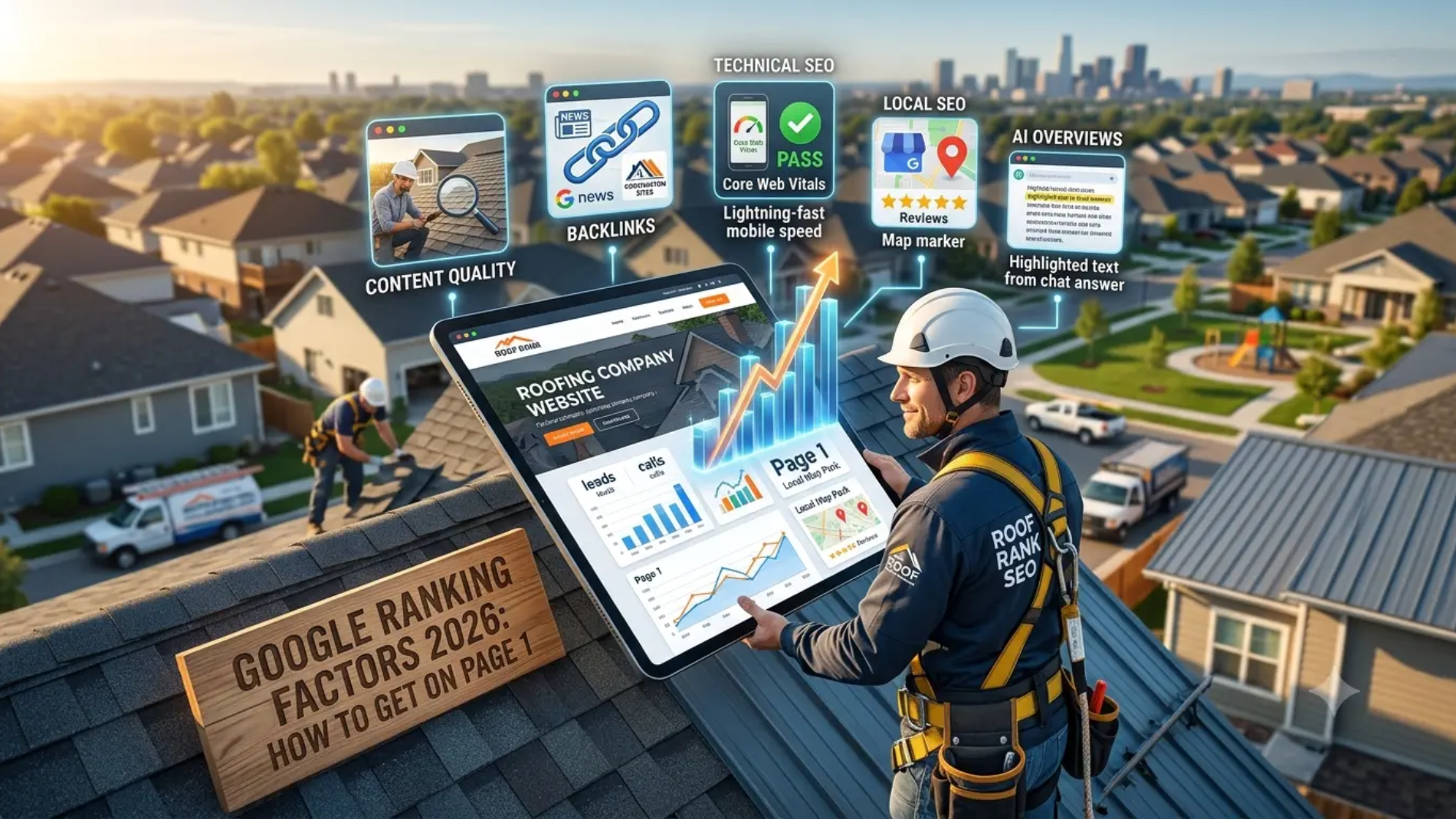
Google uses hundreds of signals, but a small group of ranking factors drive most of your results.
For roofers, the big ones in 2026 are:
- Helpful, high‑quality content that matches what homeowners actually search.
- Strong backlinks from trusted, relevant sites.
- Technical health (speed, mobile, Core Web Vitals, crawlability).
- Local SEO signals (Google Business Profile, reviews, NAP consistency).
- User engagement: clicks, time on page, low bounce rate.
Stop Losing Roofing Jobs to Competitors
If your website isn’t on Page 1, you are giving away thousands of dollars in commercial roofing jobs to local competitors every month. Let’s change that.
These are the top SEO ranking factors 2026 you should prioritize before worrying about minor tweaks.
Helpful Content: Still Ranking Factor #1
Every major ranking factors study now agrees: content quality and relevance are the single most important SEO ranking factors 2026.
For roofing SEO, “quality content” means:
- Service pages that clearly explain each roofing service (install, repair, replacement, storm damage).
- Location pages targeting each city or state you serve.
- Blog posts that answer homeowner questions, like “Do I need a roof replacement or repair?” or “How long does an asphalt roof last?”
Google looks for pages that satisfy search intent, cover topics in depth, and use simple, clear language. Long, helpful articles, often 1,400+ words, rank better than thin, generic content.
Keywords in 2026: Depth Beats Density
Keywords are still vital, but how you use them has changed.
Instead of stuffing your main keyword, such as “google ranking factors 2026” or “roofing SEO services,” into every sentence, focus on:
- Using the primary keyword in the title, meta description, URL, H1, and first 100 words.
- Adding related terms (LSI keywords) and semantic phrases like “top SEO ranking factors 2026,” “search engine ranking factors 2026,” and “local SEO ranking factors 2026.”
- Building topic clusters: one main page (e.g., “Roofing SEO Services in USA”) supported by blogs on specific questions.
Instead of just guessing what homeowners type, Google in 2026 looks for “Entity Depth.” For a roofing contractor, this means matching commercial intent with localized search behaviors.
Here is how we map keywords to capture high-ticket roofing jobs:
| Search Intent Type | Keyword Example for Roofers | Where It Belongs in Your Funnel |
| Commercial / High Intent | “Emergency storm damage roof repair [City Name]” | Service Landing Page (Direct Lead Gen) |
| Local / Map Intent | “Best metal roofing contractor near me” | Google Business Profile & Geo-Targeted Page |
| Informational Intent | “How to spot hail damage on shingles after a storm” | Blog Post / Lead Magnet Hub |
Google’s newer systems look at semantic fit and search intent, not just keyword density. This means a well‑structured roofing blog that answers related sub‑questions will usually beat a shorter, keyword‑stuffed article.
Backlinks: Votes of Trust for Roofers
Backlinks remain one of the top SEO ranking factors 2026 because they show Google other sites trust you.
Key backlink truths for roofing companies:
- Quality beats quantity: a few links from local news, industry blogs, suppliers, or chambers of commerce are more powerful than hundreds of low‑quality directory links.
- Relevant links matter more: links from construction, home improvement, insurance, or local community sites carry more weight than random blogs.
- Natural link profiles: a mix of guest posts, digital PR, local sponsorships, and citations looks healthy; spammy patterns trigger filters.
In 2026, Google’s systems and spam updates still devalue link schemes, link spam, and mass low‑quality directories, but reward ethical link‑building and “linkable assets” like original guides or storm‑damage checklists.
Technical SEO & Core Web Vitals
Search engines cannot rank what they cannot crawl, and users will not stay on slow, broken sites.
Google’s Page Experience signals are unforgiving in 2026. If your roofing website takes more than 3 seconds to load on a mobile device while a homeowner is dealing with an active ceiling leak, you lose the job instantly.
Ensure your technical metrics meet these strict 2026 benchmarks:
| Core Web Vital | What It Means for Your Roofing Site | Target Benchmark |
| LCP (Largest Contentful Paint) | How fast your high-res roof replacement portfolio images load. | Under 2.5 Seconds |
| INP (Interaction to Next Paint) | How quickly your site responds when a user clicks “Get a Free Quote”. | Under 200 Milliseconds |
| CLS (Cumulative Layout Shift) | Preventing text/buttons from jumping around while a user tries to tap your phone number. | Less than 0.1 |
Top technical SEO ranking factors 2026 Moz and other sources highlight include:
- Site speed and Core Web Vitals: Largest Contentful Paint (LCP), Interaction to Next Paint (INP) and Cumulative Layout Shift (CLS) are now “more than a tiebreaker.”
- Mobile‑friendliness: mobile‑first indexing means your roofing site must work perfectly on phones.
- Clean architecture and internal linking: clear navigation, XML sitemaps, canonical tags, and logical URL structure help Google understand and index your pages.
- Structured data (schema): using Article, LocalBusiness, Service and FAQ schema can improve how your roofing content appears in SERPs, often via rich results.
Roofing sites that load fast, avoid technical errors, and make it easy for Googlebot to crawl all key service and location pages consistently rank higher.
Is Your Roofing Website Losing Leads to Competitors? Google’s algorithm updates can wipe out organic traffic overnight if your site lacks trust signals. Don’t leave your pipeline to chance.
Get Your Free 20-Point Roofing SEO Audit Now We’ll show you exactly why your local competitors are outranking you and how to fix it.
User Experience & Engagement Signals
User experience is now deeply tied to rankings. Google measures how real users interact with your roofing pages.
Important signals include:
- Click‑through rate (CTR) from search results.
- Dwell time, how long users stay on your page before going back.
- Bounce rate and “pogosticking”, when users quickly return to Google to click another result.
Pages that promise one thing in the title (“Emergency Roof Repair Near Me”) but deliver something else will have poor engagement and drop over time. Clear headings, short paragraphs, bullet lists and helpful visuals help keep users on the page longer.
Local SEO Ranking Factors 2026 for Roofers
For roofers in the USA, local SEO ranking factors 2026 may matter even more than national organic rankings
Key local signals:
- Google Business Profile (GBP): categories, description, hours, service area, photos, and regular updates are core to Maps and Local Pack rankings. GBP signals can carry around a third of the Local Pack weight in some studies.
- Reviews: volume, recency, rating, and detailed review text with relevant keywords (e.g., “roof replacement,” “storm damage”) strongly influence visibility and conversion.
- NAP consistency: your Name, Address, Phone must match across your website, GBP, and citations like Yelp, Angi, and local directories.
- Local links and citations: mentions from local news, chambers, builders, and community organizations build prominence.
AI‑driven local results in 2026 (like AI overviews and chat‑style answers) still pull from the same fundamentals: strong GBP data, trustworthy reviews, and complete, high‑quality roofing content on your site.
Keywords for Local Roofing SEO
Local search engine ranking factors 2026 blend traditional keywords with location and entity data.
For roofing companies, you should:
- Target service + city phrases like “roof repair Dallas,” “metal roof installation Denver,” and “emergency roofer Chicago.”
- Use geo‑keywords in titles, H1s, and early paragraphs on service and location pages.
- Include semantic variations like “roofing contractor near me,” “licensed roofer,” and “insurance roof claim help.”
Google links these phrases with your entity (your roofing brand) through GBP, schema, and consistent NAP information, which boosts local relevance.
E‑E‑A‑T, Brand Signals and Social Proof
Google continues to reward sites that show Experience, Expertise, Authoritativeness and Trust (E‑E‑A‑T).
For roofers, that means:
- Showing real project photos, case studies and before‑after galleries.
- Listing licenses, certifications, warranties, and insurance details.
- Publishing content with clear authorship and update dates.
Brand and social signals, like branded searches, social media activity, and mentions in local media, help Google see your roofing company as a real business, not a thin affiliate site.
This is why it helps to build a consistent presence on Facebook, Instagram and other platforms alongside your website.
Is SEO Dead or Evolving in 2026?
Multiple up‑to‑date studies show SEO is not dead in 2026, it has evolved to include AI search surfaces, richer SERP features, and stricter spam controls.
What changed:
- AI Overviews and chat‑style answers now surface trusted brands and high‑quality content more prominently.
- Review quality, sentiment and entity understanding matter more.
- Technical expectations (Core Web Vitals, structured data, mobile) are stricter.
What stayed the same:
- Helpful content, backlinks, and strong local signals still drive rankings.
- Roofing companies that invest consistently in fundamentals outperform those chasing quick hacks.
How Roof Rank SEO Helps Roofers Dominate 2026
Roof Rank SEO focuses specifically on roofers in the USA who need any type of SEO services, from on‑page optimization to full local and national campaigns.
Using the latest google ranking factors 2026, we:
- Build intent‑driven service and location pages that answer homeowner questions clearly.
- Develop content hubs on roofing topics (materials, storm damage, insurance claims, maintenance).
- Earn high‑quality backlinks and local mentions, not spam links.
- Fix technical issues, improve Core Web Vitals, and implement schema for services, locations and FAQs.
- Optimize and maintain your Google Business Profile and review strategy.
If you want to outrank competing roofers, Roof Rank SEO can design a funnel‑driven SEO strategy that turns search traffic into calls and booked jobs. You can visit our social media Facebook & Instagram to see real‑world roofing SEO results and case studies.
Advanced 2026 Schema Requirements for Roofers
{ “@context”: “https://schema.org”, “@type”: “RoofingContractor”, “name”: “Your Roofing Company Name”, “image”: “https://yourwebsite.com/images/hero.jpg”, “url”: “https://yourwebsite.com”, “telephone”: “+1-555-555-5555”, “priceRange”: “$$”, “address”: { “@type”: “PostalAddress”, “streetAddress”: “123 Main Street”, “addressLocality”: “Dallas”, “addressRegion”: “TX”, “postalCode”: “75201”, “addressCountry”: “US” }, “geo”: { “@type”: “GeoCoordinates”, “latitude”: 32.7767, “longitude”: -96.7970 }, “openingHoursSpecification”: { “@type”: “OpeningHoursSpecification”, “dayOfWeek”: [ “Monday”, “Tuesday”, “Wednesday”, “Thursday”, “Friday”, “Saturday” ], “opens”: “07:00”, “closes”: “19:00” } }Ready to Dominate Your Local Market?
Roof Rank SEO builds custom, high-converting SEO engines specifically for US-based roofing contractors. Let’s pack your pipeline with commercial and residential leads.
FAQs
What are Google’s ranking factors?
They are signals Google uses to decide which pages to show and in what order, covering content, links, technical health, user experience, and local/business trust.
What is the Google ranking system?
It is a group of algorithms and AI models that evaluate hundreds of factors (including helpfulness and relevance) to generate search results for each query.
How to get top 10 rank in Google?
Create the best page for the query, earn trusted backlinks, fix technical issues, and build strong local/review signals, then maintain and improve your content over time.
What are the 4 types of SEO?
Commonly: technical SEO, on‑page SEO, off‑page SEO (links and mentions), and local SEO for map and area‑based searches.
Is SEO dead or evolving in 2026?SEO is evolving; AI and new SERP formats changed how results appear, but sites that follow core ranking factors still gain traffic and leads.