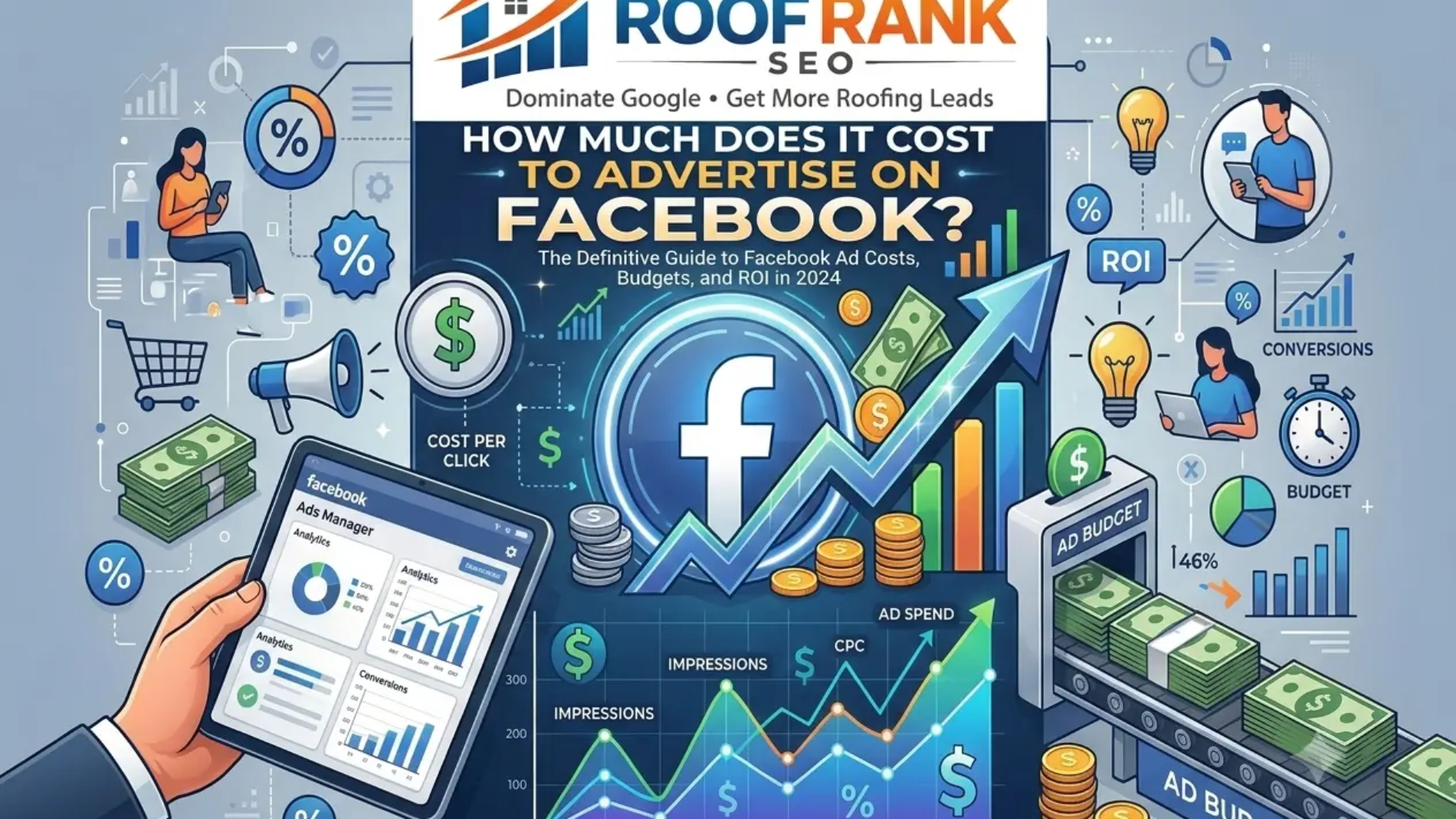
Facebook advertising costs for roofers can start small, but results depend on the goal, market, audience, and ad quality. A local roofing company may test with $10 a day, while a busy metro campaign may need far more to generate steady, qualified estimates.
The useful question is not only, “How much cost Facebook advertising?” It is, “How much can we pay for a booked roofing job and still make a profit?” This guide gives you a clear way to answer both.
At Roof Rank SEO, we help roofing companies connect paid social campaigns with local SEO, landing pages, and lead tracking. That turns clicks into calls, inspections, and signed jobs.
Quick answer: Facebook ads have no fixed price. Many current benchmarks place clicks around $0.70–$0.87 and 1,000 impressions around $13.57–$16.06. Roofing costs can be higher because local homeowner leads are valuable and competitive.
Facebook advertising costs at a glance
Facebook, now part of Meta’s ad system, uses an auction. You choose a budget, but you do not buy a flat-rate ad slot.
Instead, Meta looks for chances to show your ad to people likely to take your chosen action. Your final cost changes with every auction.
| Cost metric | What it means | Simple roofing use |
| CPM | Cost per 1,000 impressions | Measure local reach and storm-season awareness |
| CPC | Cost per link click | Measure visits to a roofing estimate page |
| CPL | Cost per lead | Measure form fills, calls, or instant-form inquiries |
| CPA | Cost per acquisition | Measure a desired result, such as a booked inspection |
| ROAS | Revenue divided by ad spend | Measure revenue earned for each ad dollar |
A low CPC can look good while producing poor leads. For most roofers, cost per qualified inspection and cost per sold job matter more.
Typical benchmark ranges
Use market averages only as a starting point. They are not a promise.
| Benchmark | Planning range | What can change it |
| Cost per click | $0.70–$2.50+ | Goal, audience, creative, and local competition |
| Cost per 1,000 impressions | $10–$25+ | Location, season, placement, and demand |
| Cost per lead | $15–$100+ | Offer, form friction, lead quality, and follow-up |
| Cost per booked roofing estimate | Varies by close rate | Call speed, service area, and sales process |
Roof repair, roof replacement, and storm restoration can carry a higher cost to advertise on Facebook than low-value products. That is normal when a single completed job has strong revenue potential.
How Facebook ad pricing works
Facebook ads are sold through auctions across Facebook, Instagram, Messenger, and other eligible placements. You set a campaign objective, audience, schedule, ad creative, and budget.
Meta then decides whether your ad should win each available impression. The highest bid does not automatically win.
The three parts of ad value
Your ad competes on more than money. Meta considers the following signals.
- Bid or budget strategy: What you are willing to spend for results.
- Estimated action rate: How likely the viewer is to take your selected action.
- Ad quality: How relevant and useful the system expects your ad to be.
A helpful roof-repair offer, clear photo, and fast landing page can beat a generic ad with a larger bid. Strong relevance often makes Facebook advertising costs more efficient.
You usually pay for delivery, not a fixed result
Many advertisers speak about paying per click or lead. In practice, Meta often buys impressions and optimizes delivery toward the outcome you selected.
That means your CPC, CPL, and CPA are performance results. They are not guaranteed price tags.
For example, two roofing contractors can spend the same $30 daily budget. The contractor with a clearer offer and better lead response may get more estimate requests.
What makes Facebook ads cost more?
Several factors can raise or lower your Facebook ads cost. Control the factors you can, then measure the rest.
Your campaign goal
Choose the result that matches the job you need done. Traffic campaigns usually find people likely to click.
Lead campaigns find people more likely to submit a form. Sales or conversion campaigns seek people more likely to complete the tracked action.
For a roofing contractor, use these goal-to-funnel matches:
| Business goal | Better starting objective | Main success metric |
| Build local name recognition | Awareness | Reach and CPM |
| Send homeowners to a service page | Traffic | Landing-page views |
| Collect inspection requests | Leads | Cost per qualified lead |
| Create booked appointments | Leads or sales with tracking | Cost per booked inspection |
| Reconnect with past visitors | Leads or sales retargeting | CPA and conversion rate |
Avoid choosing traffic when you need estimate requests. Cheap clicks from people with no roofing need can waste a budget.
Audience location and competition
Local targeting is essential for roofers. A campaign in Dallas, Denver, Miami, or another large market often faces more advertiser competition.
A service area that is too wide can collect leads outside your crew’s range. One that is too narrow can limit delivery and raise frequency.
Start with the cities, ZIP codes, or radius your team can serve quickly. Then exclude locations you cannot cover.
Seasonal demand and weather events
Costs can rise when more businesses chase the same attention. Holiday retail periods can lift auction prices.
For roofing, weather can also change demand. After hail, wind, or heavy rain, homeowner interest may rise along with competition.
Do not pause a profitable campaign only because CPM goes up. Compare the final cost per booked inspection and sold job.
Ad quality and creative fatigue
People scroll quickly. An ad with weak images, vague copy, or a confusing offer may receive fewer positive signals.
When the same audience sees an ad too often, performance can fall. This is called ad fatigue.
Refresh your creative before fatigue becomes expensive. Test a new roof photo, video hook, homeowner proof point, or offer.
Placement and format
Your ads can appear in Facebook Feed, Instagram Feed, Stories, Reels, Marketplace, and more. Each placement has different behavior and costs.
Use vertical video for Stories and Reels. Use clear square or portrait images for feeds.
Allow automatic placements during early tests when possible. Then review results before removing placements.
Landing-page experience
A Facebook ad does not finish the sale. Your page must load fast, work on mobile, and match the promise in the ad.
If the ad says “Free Roof Inspection,” the page should repeat that offer. It should show the service area, proof, and one clear form or call action.
Roofing Facebook ad budget: a practical plan
There is no universal daily spend. The right budget depends on your target cost per qualified lead and how many leads you need.
Start with a number you can afford to test without stopping too soon. Then give each test enough time and data.
Budget by business stage
| Stage | Suggested daily test budget | Best focus |
| New local campaign | $10–$20 | One offer, one area, two creative versions |
| Active lead generation | $20–$50 | Estimate requests and call tracking |
| Established multi-city campaign | $50–$150+ | Scale winning areas and retarget visitors |
| Storm-response campaign | Based on crew capacity | High-intent local leads and fast follow-up |
These are planning ranges, not platform rules. If your target lead cost is $40, a $5 budget will not create enough results quickly.
Use a simple budget formula
Start with the business result you need. Then work backward.
Monthly ad budget=Target qualified leads×Target cost per qualified lead\text{Monthly ad budget} = \text{Target qualified leads} \times \text{Target cost per qualified lead}Monthly ad budget=Target qualified leads×Target cost per qualified lead
Example: You want 30 qualified roofing inquiries each month. Your target CPL is $45.
30×$45=$1,350 monthly budget30 \times \$45 = \$1,350 \text{ monthly budget}30×$45=$1,350 monthly budget
That is about $45 per day in a 30-day month. Next, check your close rate and average job profit before scaling.
Set a break-even lead cost
A lead is worth only what it can produce after sales costs. Use this simple formula.
Maximum lead cost=Gross profit per job×Lead-to-sale rate\text{Maximum lead cost} = \text{Gross profit per job} \times \text{Lead-to-sale rate}Maximum lead cost=Gross profit per job×Lead-to-sale rate
Example: A roofing job produces $3,000 gross profit. Your team closes 20% of qualified leads.
$3,000×0.20=$600\$3,000 \times 0.20 = \$600$3,000×0.20=$600
In theory, $600 is your break-even qualified lead cost before other costs. In real life, set a safer target below that amount.
This calculation stops you from judging ads by clicks alone.
How to lower Facebook advertising costs
Do not chase the lowest possible CPM or CPC. Aim for profitable, qualified leads.
1. Build an offer homeowners understand
Use a clear offer with a real next step. Avoid broad lines such as “Best roofing services.”
Try offers like these:
- Free roof inspection for homeowners in your service area
- Hail-damage assessment after a local storm
- Roof replacement estimate with financing options
- Same-week emergency leak inspection
Use only offers your company can honestly deliver. Clear offers attract more suitable inquiries.
2. Match one message to one audience
A homeowner with an active leak needs a different message than someone researching a future replacement. Separate those needs.
For example, run one campaign for emergency roof repair. Run another for roof replacement financing.
This improves relevance and makes the results easier to understand.
3. Use first-party data and retargeting
Install the Meta Pixel and set up accurate lead tracking. When appropriate, use Meta’s Conversions API with proper consent and privacy practices.
Then create audiences from website visitors, video viewers, lead-form openers, and customer lists. Retargeting often performs well because these people already know your roofing brand.
Always exclude people who already became leads when the offer does not apply to them.
4. Test creative, not everything at once
Test one major item at a time. Change the image, headline, offer, or audience, but not all four together.
A simple roofing test could compare:
- A homeowner testimonial video
- A before-and-after roof photo
- A storm-damage checklist image
Keep the same goal and audience. Select a winner using qualified leads, not likes.
5. Answer leads fast
An expensive lead can become profitable with fast, professional follow-up. A cheap lead can become worthless when nobody calls back.
Set a process for calls, texts, and appointment scheduling. Track whether each lead becomes an inspection, estimate, or closed job.
6. Protect the page after the click
Give visitors one job to do. Call, request an inspection, or submit a short form.
Include these trust elements:
- Service-area cities
- License and insurance details, where applicable
- Recent project photos
- Reviews or testimonials
- A working click-to-call button
- A short form with only needed questions
Keywords and Facebook ad costs
Keywords matter after people click a Facebook ad. Facebook audience targeting is not the same as search-engine keyword targeting.
A homeowner may see a roofing ad while scrolling, then later search Google for “roof repair near me.” Your website needs useful pages that match that search.
Keywords are the words and phrases people type into search engines. For a roofing company, examples include “roof replacement in [city],” “hail damage repair,” and “emergency roofer near me.”
Use keywords naturally in service pages, titles, headings, image descriptions, and helpful local content. Do not stuff them into every sentence.
This is where paid social and SEO work together. Facebook creates demand and awareness. Local SEO helps your business appear when homeowners search with high intent.
Roof Rank SEO can connect the funnel with location pages, technical SEO, Google Business Profile support, content, and conversion-focused landing pages. The goal is not just more traffic. It is more roofing opportunities.
Measure the full roofing funnel
A campaign that produces 50 leads is not automatically successful. You need to know what happened next.
Track every stage from ad view to revenue.
| Funnel stage | What to track | Why it matters |
| Ad delivery | CPM, reach, frequency | Shows cost and saturation |
| Ad engagement | CTR and landing-page views | Shows whether the message earns attention |
| Lead capture | Form leads and phone calls | Shows response volume |
| Lead quality | Service area, project type, contact rate | Removes junk leads from reporting |
| Sales | Inspections, estimates, closed jobs | Shows real business impact |
| Revenue | Revenue, gross profit, ROAS | Shows whether scaling makes sense |
A 2.5 ROAS means $2.50 in tracked revenue for every $1 spent. It may be good, weak, or excellent depending on your gross margin, overhead, and sales cycle.
For example, a company with a 70% gross margin has different needs than one with a 20% margin. Judge ROAS against profit, not a generic internet benchmark.
Common Facebook ads mistakes roofers should avoid
Most wasted ad spend comes from a broken process, not a single setting.
- Sending ad clicks to the homepage instead of a focused service page
- Using a traffic goal when the real goal is lead generation
- Targeting outside the service area
- Ignoring call tracking and offline lead outcomes
- Promising instant service when the team cannot respond
- Using one ad for months without creative refreshes
- Changing budgets, audiences, and creative every day
- Optimizing for cheap leads instead of qualified appointments
- Failing to exclude existing leads from new-lead campaigns
- Running ads without a clear privacy notice and consent process
A 30-day Facebook ads launch plan
Use this plan when starting a new roofing campaign. Keep it simple enough to learn from the data.
Days 1–5: Build the foundation
Choose one core offer. Create one landing page and install lead, call, and appointment tracking.
Prepare two to three visual options. Confirm that your sales team can respond quickly.
Days 6–14: Launch controlled tests
Run one campaign objective with a realistic daily budget. Test two ads against the same audience.
Do not declare a winner after a few clicks. Look for patterns in lead quality and booked inspections.
Days 15–21: Improve the weakest link
If clicks are costly, improve your hook, creative, or audience fit. If leads are costly, improve the offer or form.
If leads are cheap but poor, tighten qualification and review the landing-page message.
Days 22–30: Scale carefully
Move budget toward the best performer. Increase spending gradually rather than doubling it overnight.
Add a retargeting campaign for website visitors and video viewers. Keep tracking real appointments and job revenue.
Are Facebook ads worth it for roofing companies?
Facebook ads can work well for roofers when they fit a complete local marketing system. They are especially useful for building awareness, promoting seasonal services, retargeting visitors, and generating inspections.
They should not replace local SEO. A homeowner often sees an ad, researches your company, reads reviews, and searches your name or services before calling.
The strongest approach combines paid ads with a fast website, local service pages, good reviews, accurate tracking, and a trained sales team.
Get more from every roofing click
Facebook ads can generate local attention fast. SEO builds lasting visibility when homeowners search for roofing help.
Roof Rank SEO helps U.S. roofing companies build both sides of that funnel. We align local SEO, content, landing pages, tracking, and lead growth around your service areas.
Ready to turn your Facebook ad budget into better roofing leads? Contact Roof Rank SEO for a roofing-focused growth plan.
You can also follow Roof Rank SEO on Facebook and Instagram for practical roofing marketing tips, local SEO updates, and lead-generation ideas.
Frequently asked questions
Is $10 a day enough for Facebook ads?
Yes, it can test one local audience and offer, but it may produce limited data and few leads.
How much do Facebook ads cost per 1,000 views?
Many advertisers plan around $10–$25 CPM, but market, season, audience, and creative can change the amount.
Is $100 enough for Facebook ads?
Yes, $100 can fund a short test, but it rarely proves long-term lead performance by itself.
How much does it cost to advertise something on Facebook?
You set the budget, and results vary with auction competition, objective, audience, ad quality, and campaign duration.
Is $5 a day good for Facebook ads?
It can test basic awareness, but it is usually too little for dependable local lead-generation learning.
How much is a 30-second ad worth?
A 30-second Facebook video has no fixed rate; value depends on delivery, views, leads, and revenue.
Is it worth paying for ads on Facebook?
Yes, when tracking shows that qualified leads and profit exceed the total cost of ads and management.
Why are Facebook ads limiting my daily budget to $50?
A payment, account, campaign, or spending-limit setting may apply; review Ads Manager and account billing details.
What is the 70/20/10 rule for marketing budget?
It commonly means 70% for proven tactics, 20% for growth tests, and 10% for new experiments.
How much does FB pay for 100,000 views?
Facebook ad buyers pay Meta for delivery; creator payouts vary and are separate from advertising costs.
What are common FB ads mistakes to avoid?
Avoid weak offers, vague targeting, poor tracking, slow follow-up, mismatched landing pages, and judging success by cheap clicks.
What are the best days to run Facebook ads?
Run ads when your audience can respond and your team can follow up; performance data should guide scheduling.
Is $500 enough for Facebook ads?
Yes, $500 can support a meaningful local test when you focus on one offer, audience, and conversion goal.
How do I promote an FB page?
Post helpful local content, invite real customers to follow, use Page promotion campaigns, and link the page from your website.
Is a 2.5 ROAS good?
It can be good if your margin and overhead support profit after fulfillment, sales, and management costs.
Is FB losing popularity?
Usage changes by audience, but campaign value depends on whether your local homeowners respond and convert.
Do Facebook ads actually work?
They work when the offer, audience, creative, page, tracking, and follow-up process work together.
Editorial note: Cost figures are planning benchmarks, not guarantees. Review your own Ads Manager, call tracking, and closed-job data before making budget decisions